How Our Schools Are Funded -
Cómo se Financian Nuestras Escuelas
EL ESPAÑOL ES ABAJO
Understanding Our School District is the First Step to Changing It
How Our Schools are Funded
Sonoma Valley Unified is funded differently from most California school districts, and understanding that difference is the key to understanding everything else. Here is how it works, in plain language.
🏠 Local property taxes, the biggest piece
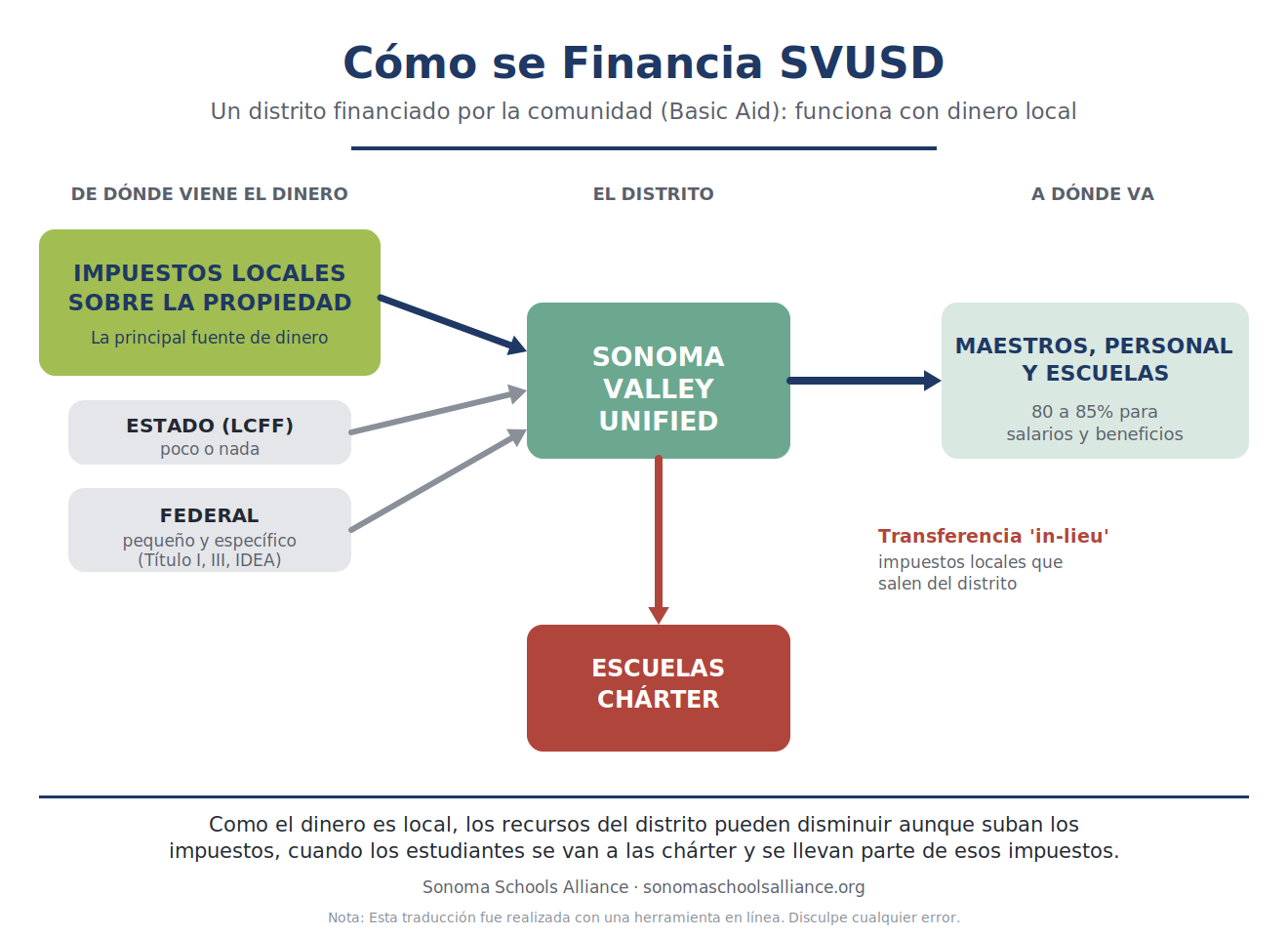
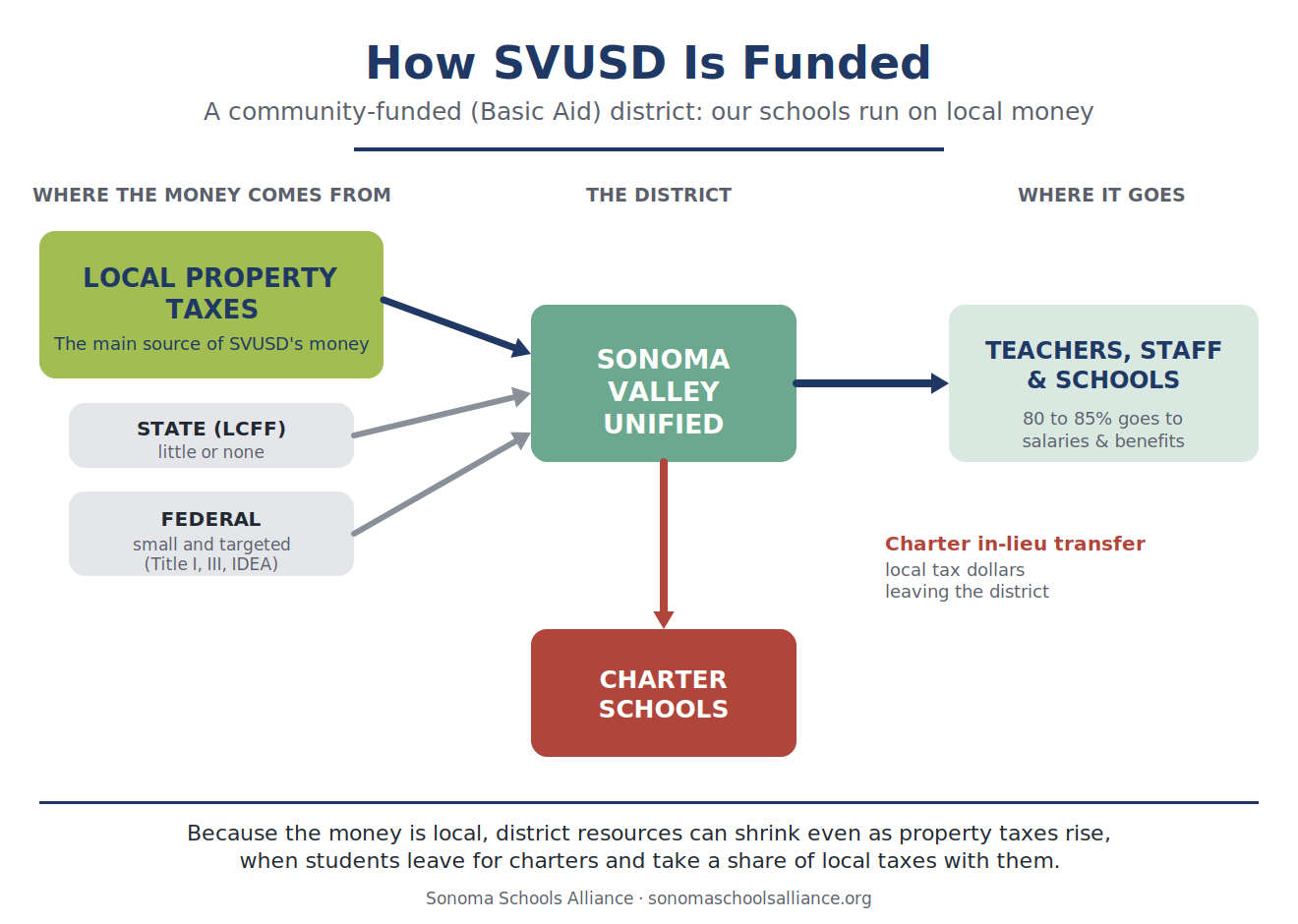
SVUSD is what California calls a Basic Aid district, sometimes called a community-funded district. That means our schools are funded mainly by local property taxes collected right here in Sonoma Valley, not by the state. Most California districts depend on the state for the bulk of their money. SVUSD does not. Our community is the main funder of its own schools.
🏛️ Why the state sends so little
Most California districts are funded through a state formula called the Local Control Funding Formula, or LCFF, which pays districts based on how many students they enroll. SVUSD is an exception. Because our local property taxes already exceed what that state formula would provide, the district keeps its property taxes and receives little or no LCFF money from the state. Here, the local community, not Sacramento, pays for the schools.
📊 What that means for the budget
Because the money is local, it does not rise and fall with state budgets the way most districts' funding does. Local property taxes tend to be stable, and they generally rise over time as property values increase. So when district resources shrink even as property taxes go up, the cause is not the state cutting funding. It is money leaving the district from the inside.
🏫 Where the local money goes, and why charters matter
When a student leaves SVUSD to attend a charter school, the district is required to transfer a share of its local property taxes to that charter, a payment called the in-lieu transfer. As charter enrollment grows, more local property-tax money is transferred out, even though the district's property-tax base has not shrunk. This is why charter growth is a budget issue in a community-funded district like ours. The money follows the students out, dollar by dollar, while the local tax base stays the same.
💰What that costs us: according to the district's own records, released to us under the Public Records Act, MacArthur Park Charter alone is projected to transfer $2,189,883 out of SVUSD.
📉 A note on enrollment
You will often hear that fewer students means less money. That is true for the typical district funded by the state per student. It works differently here. Because SVUSD runs on property taxes, a drop in district enrollment does not directly cut the district's core revenue. What does drain it is students leaving for charters, because each one takes a share of local property-tax money with them through the in-lieu transfer.
🇺🇸 Federal funding, a smaller, targeted piece
Federal funds make up a smaller portion of the budget and are usually tied to specific programs, such as Title I for low-income schools, Title III for English learners, and IDEA for special education students. These are restricted dollars, meant for particular purposes and student groups.
💰 Where it all ends up
The large majority of any school district's budget, typically 80 to 85 percent, goes to salaries and benefits for teachers, administrators, and staff. This is why staff reductions are often one of the first visible signs of a district under financial pressure.
Entender nuestro distrito escolar es el primer paso para cambiarlo.